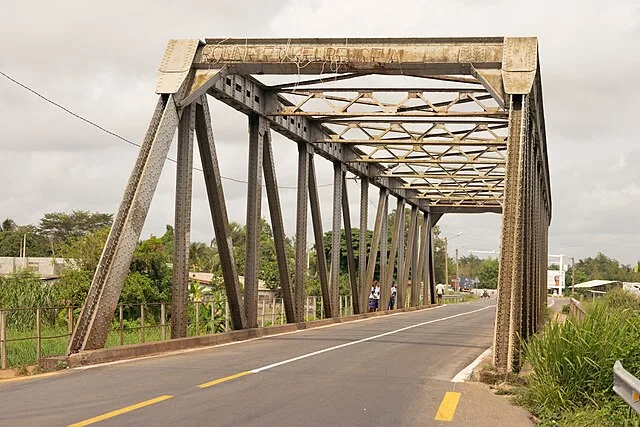
Located in southern Côte d’Ivoire, the Eiffel Bridge of Dabou is an engineering work that brings together aesthetics and function, French and Ivorian heritage. Its story dates to a period when the influence of Gustave Eiffel, the renowned French engineer and architect, extended from France to the land of Eburnie.
A Franco-Ivorian connection
The Eiffel Bridge of Dabou was built between 1921 and 1932, over roughly ten years. During the colonial period, France sought to strengthen its economic and cultural ties with one of its colonies, which would later become Côte d’Ivoire.
The bridge is 41.6 metres long and crosses the Agnéby River. It was among the first routes to link Ivorian towns, connecting northern and southern areas. Its steel structure is characteristic of Eiffel’s engineering and has an aesthetic shared by his other works. The bridge quickly became a symbol of technological progress and bilateral cooperation.
A historic emblem and more
The Eiffel Bridge of Dabou has stood the test of time, bearing witness to the quality of its original construction. Conservation efforts have been made to protect this icon of Ivorian history. Guided visits and educational initiatives now help visitors discover the history and ingenuity behind the bridge. Today it remains a legacy linking past and present, recalling Gustave Eiffel’s era and giving visible form to the shared history of France and Côte d’Ivoire.
Over the years, it has played an essential role in regional development. By facilitating movement between the two banks of the Agnéby, it has contributed to economic growth, trade and cultural exchange. Its importance is not limited to its practical use: it also shapes the everyday life of people in the region by enabling the circulation of goods and people.