
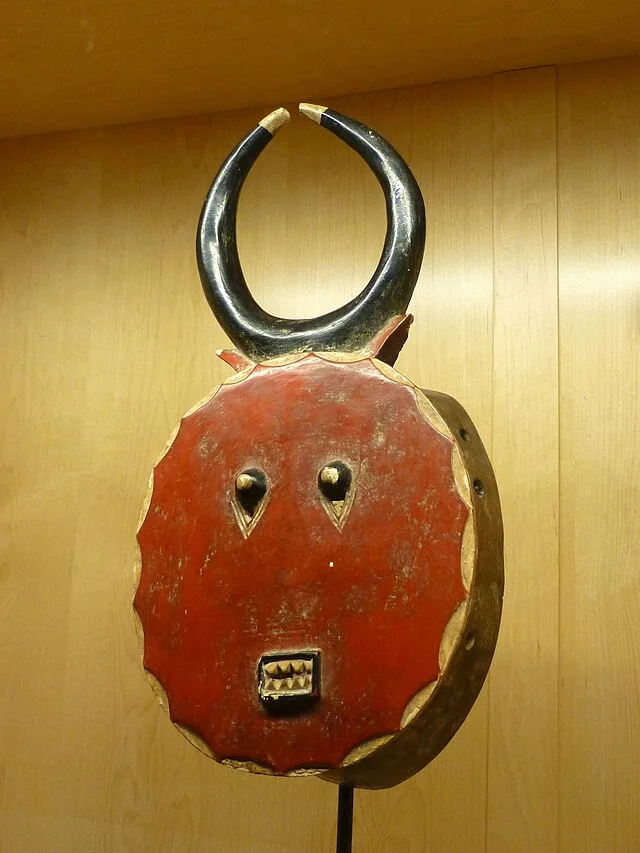
The Goli mask is a major cultural and spiritual element among the Baoulé and Wan peoples of Côte d’Ivoire. Originating with the Wan people, it was adopted by the Baoulé at the start of the twentieth century and became an important symbol of their cultural heritage.
Origins
The Goli is associated with Wan and Baoulé mythology. Among the Wan, it takes the form of a dragon and represents a spirit that temporarily inhabits the mask wearer. Among the Baoulé, it is linked to Nyamien, the god of the sky, and is considered a protective fetish, called ‘Amouin’ in the Baoulé language.
Varied appearances
The Goli mask appears in different forms, reflecting cultural variations between the Wan and Baoulé. Among the Gouro, it is a helmet mask shaped like a buffalo’s head. Among the Baoulé, it has a crocodile’s face with an elephant, and red discs at the sides representing the sun. The dancer’s costume includes an antelope-skin cape and bells on the feet.
Types of Goli masks
Several Goli masks exist, each with a specific role:
- Gloin (the father): protects the village from harm and accompanies the dead.
- Kpan (the mother): protects fertility and pregnancy.
- Kouassi Blé (the eldest son): messenger of Gloin.
- Gbakla Gboko (the second son): represents his parents at ordinary funerals.
Occasions when it appears
The Goli mask appears at important occasions including chiefs’ funerals, conflict resolution and celebrations of the birth of a ‘goli’ child. It also features at village festivities, where it retains its sacred character.
The Goli in dance
The Goli dance is a full-day performance in which several masks appear in a precise order, beginning with:
Kple Kple, then Goli Glen, Kpan Pre, and finally Kpan. Each mask carries complex symbolic meaning, representing masculine and feminine aspects.
Preservation and trade
Goli masks are valuable cultural objects, often sold with certificates of authenticity. They are kept in private and public collections, underlining their artistic and cultural importance.
The Goli mask is central to Baoulé and Wan culture, symbolising protection, fertility and a link to the divine. Its rich symbolism and ceremonial role make it a singular cultural treasure.